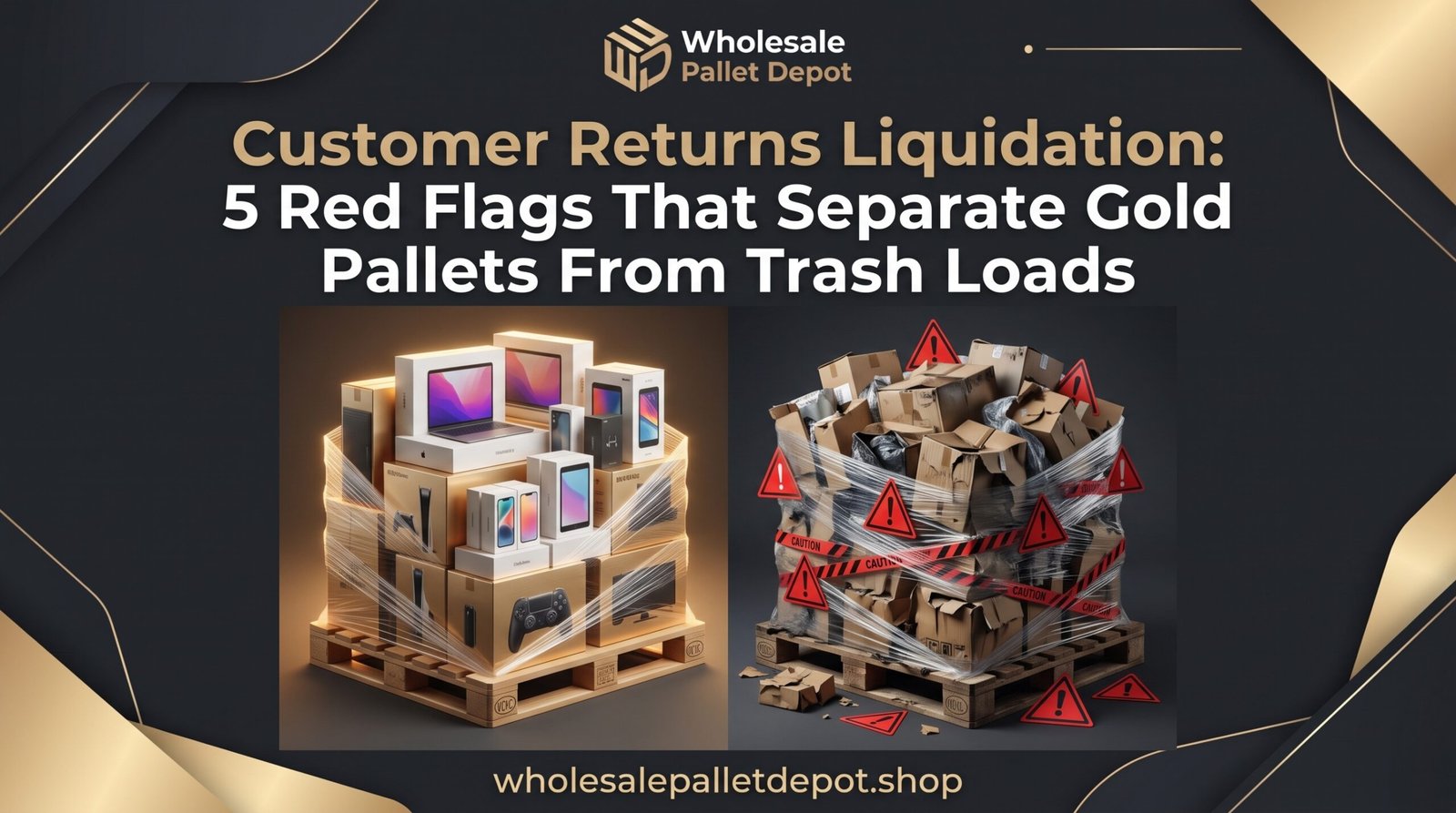
Let me be direct: customer returns liquidation can genuinely make you money. Retailers process billions of dollars in returns every year, and a real, well-established secondary market exists to move that inventory to resellers at a discount. But this same industry has also become a magnet for scams, precisely because buyers usually can’t inspect a pallet before paying for it. Security researchers at Malwarebytes have specifically documented pallet liquidation scams as a growing problem, noting that fraudulent listings have become sophisticated enough that even experienced online shoppers can struggle to tell them apart from legitimate suppliers.
The difference between a genuinely profitable pallet and a total loss almost always comes down to recognizing the same handful of warning signs before you pay. This guide walks through the five that matter most.
Customer Returns Liquidation — Red Flag #1: Pricing That Doesn’t Match Reality
Customer Returns Liquidation — What Realistic Pricing Actually Looks Like
Reputable liquidators generally price pallets somewhere between 10 and 30 percent of estimated retail value, depending on category and condition grade. If a listing promises “high-end electronics” or “brand-name apparel” priced at a small fraction of what comparable pallets sell for elsewhere, that gap is the entire warning sign. According to a detailed breakdown from American Liquidation, one of the most consistent patterns across confirmed scam listings is a seller claiming a pallet worth thousands of dollars for a tiny fraction of that price — a business simply can’t operate that way and stay solvent, so something else is going on.
Customer Returns Liquidation — Why This Red Flag Works So Well on Beginners
Unrealistically low pricing specifically targets buyers who don’t yet know what fair market value looks like in this industry. Anyone who’s bought even one or two legitimate pallets develops a rough sense of realistic pricing by category — which is exactly why researching typical price ranges before your first purchase is one of the simplest ways to protect yourself. A quick, practical habit: before buying from a new supplier, search for two or three comparable pallets from other established sellers in the same category, and treat any single listing priced dramatically below that range as a signal to slow down and ask more questions rather than a stroke of luck.
Liquidation Pallet Red Flags — Missing or Vague Manifests
Liquidation Pallet Red Flags — What a Real Manifest Looks Like
A trustworthy supplier provides a manifest with specific item counts rather than vague ranges, brand names where available, and condition grading — new, open-box, damaged, or salvage. Listings that describe contents only as “mixed general merchandise” or “assorted customer returns” with no further detail, or that show nothing but a photo of a shrink-wrapped pallet, are giving you essentially no information to base a purchase decision on.
Liquidation Pallet Red Flags — Reading Between the Lines on Vague Listings
Even genuinely unmanifested “mystery” pallets, which are a legitimate category on their own, should still come with some baseline information: the general retailer type, rough category mix, and condition range. Our own guide on manifested versus unmanifested loads covers this distinction in more depth — the issue isn’t that unmanifested pallets are inherently risky, it’s that a seller unwilling to provide any information at all is a different problem entirely.
Liquidation Manifest Red Flags — Questions a Real Supplier Can Answer Confidently
Beyond just checking whether a manifest exists, a few direct questions help separate genuine liquidation manifest red flags from a legitimately thin but honest listing. Ask: “Is this load manifested, and can I see it before I buy?” A documented, specific answer is a good sign. Ask: “Where does this load originate?” A named retailer channel or category, rather than a vague “major retailers,” is a good sign. Ask: “What is the delivered price to my zip code, including freight?” A supplier who can answer this clearly and immediately, without a surprise shipping quote appearing only after payment, has nothing to hide about their actual costs.
Customer Returns Pallet Scams — Payment Methods and Shipping Tricks
Customer Returns Pallet Scams — The Payment Method Red Flag
Peer-to-peer payment apps like Zelle or Cash App offer essentially zero buyer protection if something goes wrong, and legitimate wholesale liquidators typically work through business payment methods — invoiced wire transfers, ACH, or credit cards — that leave you with some recourse if a shipment doesn’t arrive as described. Wire transfer alone isn’t automatically a red flag, since it’s genuinely common in wholesale transactions, but wire-only payment combined with no verifiable business registration or return policy is a serious combination worth walking away from.
Customer Returns Pallet Scams — “Free Shipping” on Heavy Pallets Should Raise Questions
Freight costs for a standard pallet within the continental US commonly run €138 to €322 depending on distance and weight. A listing promising completely free nationwide shipping on a heavy commercial pallet, with no clear explanation of how that’s financially possible, deserves real scrutiny. Legitimate suppliers either build freight into a transparent total price or disclose shipping costs clearly before you commit to buying — what should never happen is a shipping quote that only appears after you’ve already paid.
How to Spot Bad Liquidation Pallets — Source Transparency and Stolen Photos
How to Spot Bad Liquidation Pallets — Where Did This Inventory Actually Come From
A trustworthy supplier can tell you clearly whether a pallet contains customer returns, overstock, shelf pulls, or some mix, and roughly what type of retailer it originated from. Vague answers like “direct from major retailers” without naming the type of retailer, or a seller who gets defensive when asked directly about sourcing, are exactly the pattern to watch for.
How to Spot Bad Liquidation Pallets — Recognizing Stolen or Recycled Photos
One specific tactic worth knowing about directly: some fraudulent listings use photos cloned from real, legitimate liquidation warehouses to make an otherwise empty or fake listing look credible. A simple reverse image search on a pallet photo can sometimes reveal it’s been lifted from an entirely different, unrelated business. This is a genuinely useful, low-effort check worth doing before a large purchase, especially from a supplier you haven’t worked with before.
We’ve encountered a related pattern firsthand while researching content for this site: multiple websites in specific niches — wigs and hair extensions among them — using word-for-word identical marketing copy and near-identical inflated resale value promises across supposedly unrelated businesses. That kind of duplicated content across domains is a strong, checkable signal of a low-quality or coordinated scam network rather than independent legitimate sellers.
How to Spot Bad Liquidation Pallets — The Reverse Image Search Technique in Practice
Here’s exactly how to run this check yourself: save the product photo from a listing you’re considering, then use a reverse image search tool to see where else that exact image appears online. If the same photo shows up attached to a completely different business name, a different price, or a different claimed pallet contents, you’ve found conclusive proof the listing isn’t showing you real inventory. This takes under a minute and costs nothing, which makes it one of the highest-value checks available to you before committing money to an unfamiliar supplier.
Trustworthy Liquidation Supplier — What Legitimacy Actually Looks Like
A genuinely trustworthy liquidation supplier checks every one of these boxes: realistic pricing relative to estimated retail value, a specific and detailed manifest (or honest transparency about an unmanifested load), a clearly published business address and phone number, a stated return or claims policy rather than a blanket “all sales final,” and clear, upfront shipping costs. None of these signals is proof on its own, but a supplier who fails several of them at once is telling you something important.
Trustworthy Liquidation Supplier — Checking Business Registration and Reviews
Beyond what a supplier tells you directly, a little independent verification goes a long way. Most states maintain a searchable business registration database, and a legitimate wholesale operation should show up there under the name it advertises. Reviews are worth checking too, but check them across multiple independent platforms rather than relying only on testimonials posted on the seller’s own site — a trustworthy liquidation supplier with a real track record will have a footprint beyond their own marketing pages, while a scam operation’s “reviews” are often recently posted, generic, and confined entirely to the site trying to sell you something.
If you’re newer to this industry, our guide on getting licensed to buy liquidation pallets and our comparison of shelf pull pallets versus customer returns are both worth reading before your first purchase, and the FTC’s general guide to avoiding online scams applies directly to vetting any new supplier you haven’t worked with before.
Buy Customer Returns Liquidation Pallets from Euro Liquidation Hub
At Euro Liquidation Hub, we publish our full shipping policy and refund and returns policy clearly, rather than burying terms in fine print or offering none at all. Browse our Customer Returns category and full Pallets category for current inventory with honest condition information, or reach out through our contact page if you have questions before you buy.
👉 Browse all liquidation pallets for sale at [website]
FAQs About Customer Returns Liquidation
What percentage of a customer returns pallet is typically sellable?
Realistic expectations generally run 60 to 80 percent sellable from a reputable supplier, with the remainder needing repair or best suited for parts. Budgeting for some unsellable inventory upfront is standard practice, not a sign of a bad pallet.
How can I tell if a liquidation pallet price is realistic?
Legitimate pallets are typically priced at 10 to 30 percent of estimated retail value. If a listing promises high-value merchandise for a price far below that range, treat it as a serious warning sign rather than a lucky find.
Is it a red flag if a supplier requires wire transfer or ACH payment?
Not by itself — this is common in legitimate wholesale transactions. It becomes a red flag when combined with no verifiable business registration, no return policy, and no way to reach the seller beyond a generic email.
Should I trust a listing that offers free nationwide shipping?
Be cautious. Freight for a standard pallet commonly runs €138 to €322 depending on distance and weight. A seller offering completely free shipping on a heavy pallet with no clear explanation deserves extra scrutiny before you buy.
What’s the best way to verify a liquidation supplier is legitimate?
Check for a published physical address and phone number, a detailed manifest or honest unmanifested disclosure, a stated return policy, and reviews that appear across multiple independent platforms rather than only on the seller’s own site.
Where can I buy legitimate customer returns liquidation pallets?
Euro Liquidation Hub publishes clear shipping and return policies and honest condition information on every listing. Browse our Customer Returns category or full shop page for current inventory.
Euro Liquidation Hub — Your trusted national source for liquidation pallets for sale. Verified inventory, honest grading, and real customer support — shipped to your door anywhere in the country.